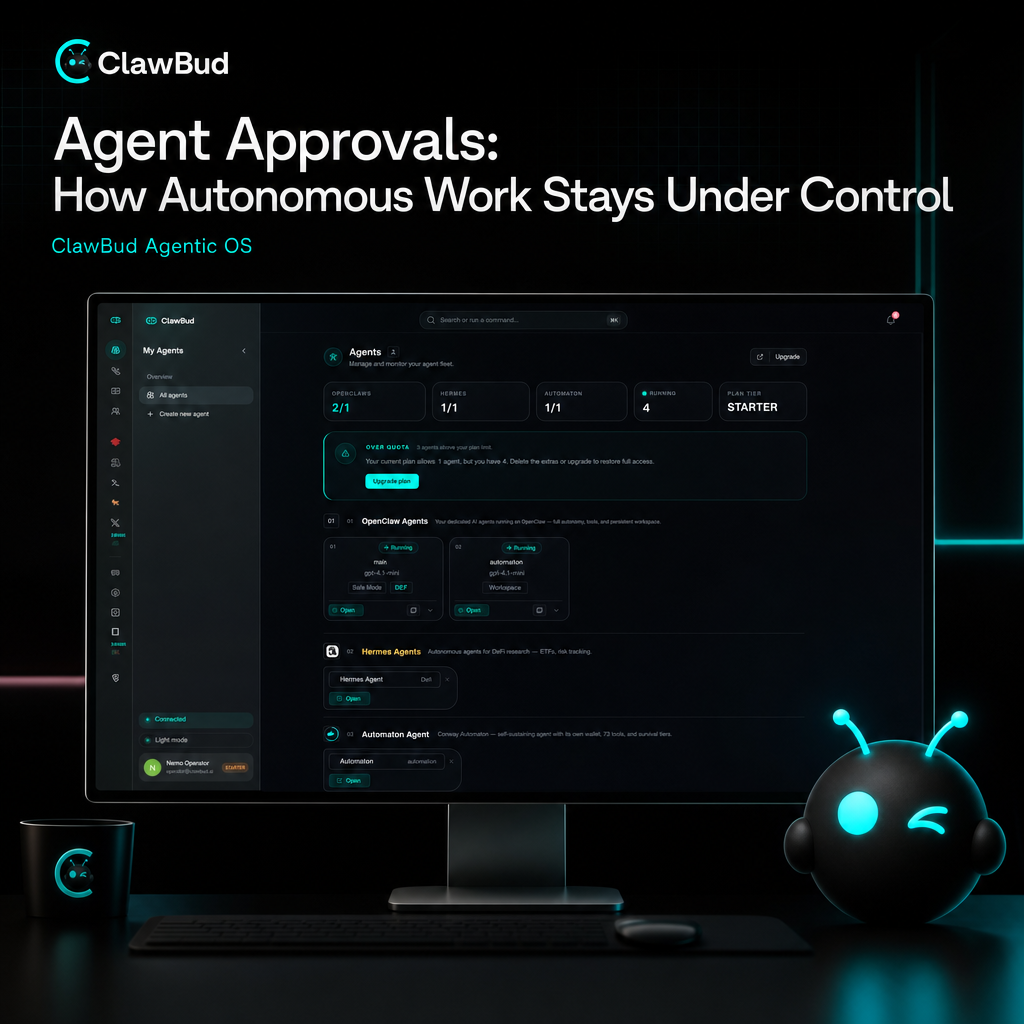
AI agents become useful when the operating environment around them is clear.
That is the product truth behind ClawBud: a fully managed Agentic OS for your AI agent army, running on a powerful private cloud computer, with OpenClaw, Hermes, local agents, cloud agents, tools, browser access, memory, integrations, skills, MCP, Business Room, CRM, orchestration, and per agent firewall boundaries ready in clicks.
This guide focuses on safety and why it matters for real agent work.
The short version
Agent Approvals is about How Autonomous Work Stays Under Control.
The value is not another screen or another model picker. The value is operational clarity: agents know where to work, humans know what happened, and the system keeps the boring parts handled.
Target keywords for this guide: AI agent approvals, agent audit trail, per agent firewall, Agentic OS.
Why this matters now
The agent market is moving from demos to daily work. Daily work is less glamorous and much more demanding.
A demo can live in a chat window. A working agent needs tools, permissions, memory, browser access, schedules, approvals, logs, summaries, and a place to continue after the first run.
That is where ClawBud is different. It does not ask the customer to assemble the stack from scratch. It gives the customer a managed environment where the agent army can run.
The ClawBud model
ClawBud gives every customer a powerful private cloud computer for their agents. That matters because serious agent work needs a real runtime.
Shared containers are fine for simple SaaS tasks. They are not enough for agent armies that browse, run workflows, coordinate tools, install skills, use MCP, interact with files, and continue missions over time.
Inside ClawBud, the operating layer connects the pieces:
- OpenClaw agents for general autonomous work
- Hermes Agent for workflow execution
- Local agents through the desktop app
- Mission summaries for continuity
- Memory and vaults for context
- CRM and Business Room for business operations
- 1 click integrations and skills
- Per agent firewall boundaries
- Real browser access
- Premium managed support
The customer gets the work environment, not the installation burden.
What changes for the operator
The operator should not have to remember where every task lives.
A good Agentic OS should answer simple questions quickly:
- Which agent is running?
- What mission is active?
- What changed?
- What failed?
- What needs approval?
- What should happen next?
- Which tools can this agent touch?
- Which context should carry forward?
When those answers are visible, agent work becomes calmer. The system feels less like an experiment and more like a real worker layer.
What changes for the agent
Agents also need structure.
Without structure, an agent is just a smart process with too much freedom and too little memory. With structure, it has a role, tools, boundaries, mission state, and a path to continue.
That is the difference between a clever reply and useful work.
ClawBud is built around that difference.
Why keywords are not the strategy
Keywords help people find the guide. They are not the product.
The product is the operating environment: managed OpenClaw, Hermes, agent memory, cloud and local runtime, private cloud computer, Business Room, CRM, integrations, and per agent firewall boundaries.
The SEO goal is simple: when someone searches for AI agent approvals, agent audit trail, or private AI agent infrastructure, ClawBud should be the obvious answer.
Practical use cases
Developer work
A developer can run cloud agents for research and planning, local agents for repo work, and coding agents like Codex or Claude Code in a controlled environment. The mission summary carries the handoff.
Business operations
A business can use agents for support, leads, inbox work, CRM updates, reporting, and content operations. The agent army works around the business instead of becoming another disconnected tool.
Enterprise control
An enterprise can use private cloud computers, managed boundaries, approvals, and audit style summaries to keep autonomous work visible and safer.
What to look for in an agent platform
A serious agent platform should give you more than access to a model.
Look for:
- A real runtime for long running work
- Memory that can be inspected and improved
- Tool access with boundaries
- Browser access for real web tasks
- Local and cloud execution paths
- Clear mission summaries
- Integrations that do not require manual DevOps
- Support when the fragile parts break
ClawBud is designed around those requirements.
The bottom line
Agents need a real place to live.
ClawBud gives them one: a fully managed Agentic OS for your AI agent army on a private cloud computer.
That is the difference between trying another AI tool and actually putting agents to work.
FAQ
What is ClawBud?
ClawBud is the fully managed Agentic OS for your AI agent army. It gives customers a ready agent environment on a private cloud computer.
Is ClawBud only for OpenClaw?
No. OpenClaw is a core part of the stack, but ClawBud also supports a wider agent army including Hermes, local agents, coding agents, research agents, and future specialized agents.
Does ClawBud use shared containers?
No. ClawBud gives every customer a powerful private cloud computer for their agent army.
Why does an agent need memory?
Memory lets agents continue work, understand previous decisions, and avoid making the human repeat context every time.
What are per agent firewall boundaries?
Per agent firewall boundaries help separate what each agent can access and do. That makes autonomous work safer and easier to manage.
Who is ClawBud for?
ClawBud is for personal users, developers, SMBs, enterprises, and organizations that want AI agents to do real work without assembling the stack themselves.
What is the main SEO topic of this guide?
The main topic is AI agent approvals, supported by agent audit trail, per agent firewall, Agentic OS.