What happens when an AI agent fails mid-workflow?
· ClawBud editorial team
Updated September 2, 2026
By ClawBud
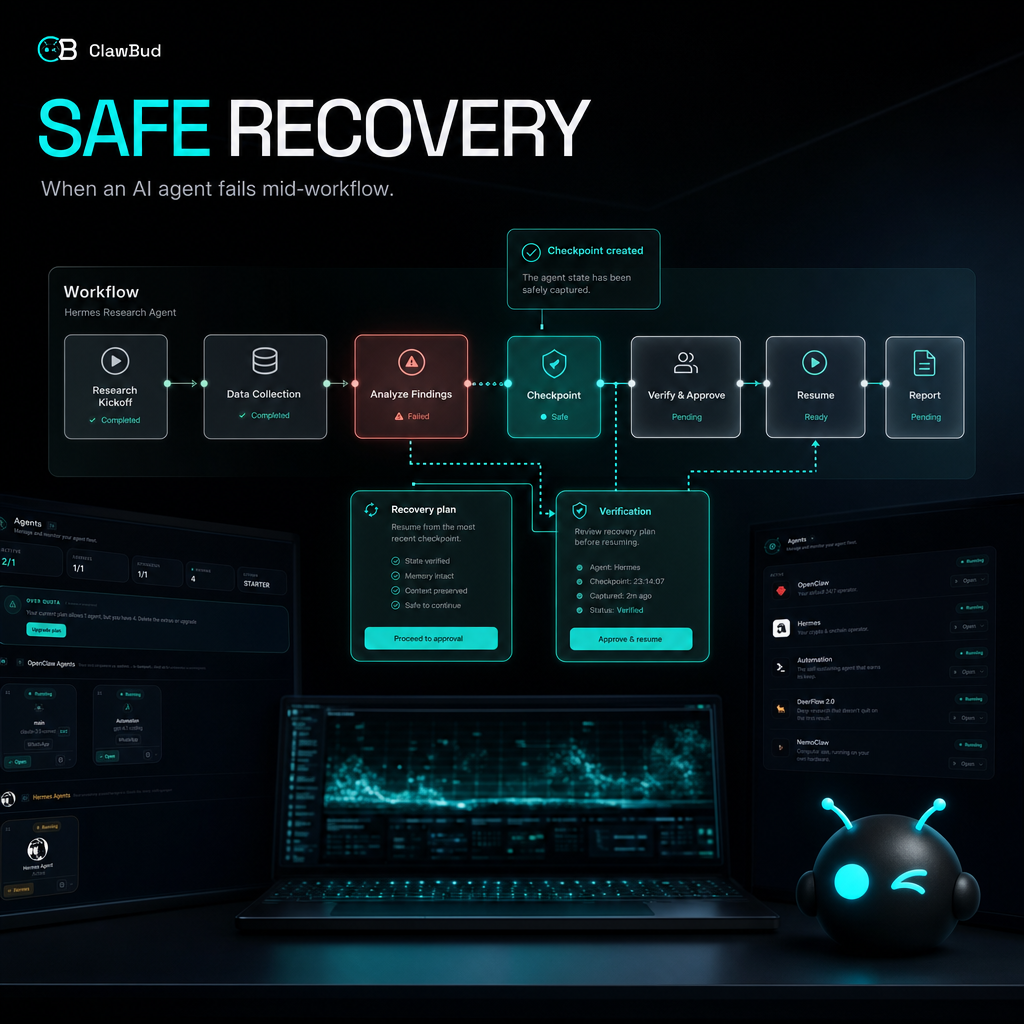
When an AI agent fails mid-workflow, stop further side effects, preserve the run state, identify the last confirmed action, and resume only from a verified checkpoint. Never assume the failed step did nothing. Before retrying, check external systems for partial completion and use an idempotency key so a repeated request cannot create a second payment, message, ticket, or record.
Quick answer. Build recovery around checkpoints, bounded retries, idempotent actions, approval gates, and a dead-letter queue for work that needs human review. If a workflow can spend money, publish, delete, or contact a customer, require verification before any retry.
Choose automatic recovery for reversible, idempotent internal work. Choose a human approval step when a retry could duplicate an external action or cause material harm.
What does mid-workflow failure mean?
A mid-workflow failure happens after an agent has started a multi-step mission but before it can confirm the final outcome. The cause might be a model error, tool timeout, expired credential, browser interruption, gateway restart, rate limit, malformed response, or an external service that accepted a request but failed to return a receipt.
The dangerous case is ambiguous completion. The agent knows it sent a request, but it does not know whether the outside system completed it. Blind retries turn one failure into two invoices, two emails, or two calendar bookings.
Which recovery controls should you choose first?
Evaluate recovery designs against these seven criteria before selecting a platform or workflow pattern.
- The damage a repeated action could cause
- Whether the action supports an idempotency key
- Whether each step writes a durable checkpoint
- How retries are limited and delayed
- Whether an operator can inspect and approve recovery
- How credentials, logs, and network access are controlled
- Whether restoration and replay are tested
| Recovery pattern | Best fit | Setup burden | Management | Privacy or security | Integrations | Main limitation |
|---|---|---|---|---|---|---|
| Automatic retry | Read-only calls and idempotent internal writes | Low | Set attempt limits, backoff, and timeout | Avoid logging secrets or sensitive payloads | Works when the tool returns reliable status | Unsafe for ambiguous external side effects |
| Checkpoint and resume | Long missions with independent stages | Medium | Store inputs, outputs, receipts, and step status | Protect state because it may contain business data | Requires tools that expose stable identifiers | Poor checkpoints can preserve the wrong state |
| Compensating action | Reversible business transactions | High | Define and test an explicit undo operation | Undo permissions need the same care as write permissions | Best with APIs that expose cancellation or reversal | Compensation may not fully erase an external effect |
| Human approval | Payments, publishing, deletion, customer contact | Medium | Route evidence and a proposed next action to an operator | Keeps consequential permissions behind review | Needs a dependable approval channel | Slower and dependent on human availability |
| Dead-letter queue | Repeated failures and malformed jobs | Medium | Triage, repair, replay, or close failed work | Restrict access and retention for failed payloads | Useful across scheduled and event-driven work | A queue stores the problem, it does not solve it |
How should a recoverable workflow be designed?
Start by splitting the mission into named steps. Each step should have a clear input, expected output, external identifier, timeout, retry rule, and success check. Record a checkpoint only after the success check passes.
Use idempotency for every write when the receiving API supports it. An idempotency key is a unique value attached to a request so the service can recognize a retry and return the original result instead of repeating the action.
OpenClaw cron jobs can run in isolated sessions and can define delivery behavior. The documentation also records job state and run history, which makes scheduled work easier to inspect. A schedule is still only a trigger. The workflow itself must decide how to handle partial completion. OpenClaw cron documentation
What should happen immediately after a failure?
Follow this order.
- Freeze dependent steps so the workflow cannot continue with incomplete data.
- Save the error, timestamp, step input, tool response, and correlation identifier.
- Query the external system for a receipt or resulting object.
- Classify the outcome as failed, completed, or unknown.
- Retry only when the operation is safe and the attempt limit allows it.
- Send unknown or exhausted work to human review.
- Verify the final state before marking the mission complete.
OpenClaw's gateway troubleshooting guide recommends checking gateway status, health, logs, and channel probes in a defined order. That is useful for separating a runtime outage from a workflow defect. OpenClaw gateway troubleshooting
How should retries work?
Use a small attempt limit and exponential backoff with jitter. Backoff gives a rate-limited or overloaded service time to recover. Jitter prevents many failed jobs from retrying at exactly the same moment.
Do not retry authentication failures until the credential problem is fixed. Do not retry validation failures without changing the input. Do not retry a timed-out external write until you have checked whether it completed. Retry logic should respond to the error class, not merely to the presence of an error.
OpenClaw's queue documentation explains how session-aware queue modes control whether new messages are collected, followed up, or handled separately while a run is active. Queue behavior can prevent overlapping work, but it does not provide transaction guarantees for outside services. OpenClaw queue documentation
How do webhooks change the failure model?
Webhooks add two boundaries. The sender may retry delivery, and the receiving workflow may retry its own action. Both layers need a stable event identifier so the same event is not processed twice.
Authenticate the webhook, validate its body, store the event identifier, and return a response only after the event has been durably accepted. OpenClaw documents webhook tokens, allowed agent identifiers, payload limits, and optional session-key restrictions. Those controls reduce exposure, but the business workflow still needs deduplication. OpenClaw webhook documentation
Which actions need human approval?
Use human approval when an action is hard to reverse or when the system cannot establish whether the first attempt succeeded. Payments, refunds, public posts, destructive file operations, production changes, legal communications, and messages to customers deserve a deliberate gate.
The approval request should contain the intended action, evidence from the failed run, the external system's current state, the proposed recovery, and the consequence of doing nothing. “Retry?” is not enough context for a responsible decision.
OpenClaw treats its gateway and tools as a high-trust control plane. Its security guidance recommends narrow exposure, strong authentication, and careful tool-policy review. Recovery permissions should be narrower than normal operating permissions whenever possible. OpenClaw security guidance
How do you verify recovery before production?
Run failure drills against a non-production target.
- Interrupt the model response after a tool call is sent.
- Return a timeout after the external service creates a record.
- Revoke a credential during the third step.
- Restart the runtime while a mission is active.
- Deliver the same webhook twice.
- Exhaust the retry limit and inspect the human-review package.
- Restore from a checkpoint and confirm no earlier action repeats.
For every drill, compare the agent's mission state with the external system. A green internal status is meaningless when the customer received two messages.
Where does ClawBud fit?
ClawBud is the fully managed Agentic OS for an AI agent army, including managed OpenClaw on a private cloud computer. It fits teams that want the runtime, dedicated browser, dedicated firewall, health monitoring, and operating support managed together. Those current product facts are listed on ClawBud's pricing page. ClawBud pricing
ClawBud can reduce infrastructure and runtime management, but it cannot make an unsafe business workflow safe by itself. Buyers still need to define approval boundaries, retry rules, success checks, and the owner of every consequential action.
ClawBud is not the right fit for a team that must own the base image, custom network topology, telemetry pipeline, and every recovery mechanism. Self-hosted OpenClaw is a better fit in that scenario. A managed VPS may also suit developers who want quick infrastructure but prefer to operate the application themselves.
What are the limits of automated recovery?
No recovery design can guarantee exactly-once behavior across every external service. Some APIs do not support idempotency, some side effects cannot be reversed, and some outages leave completion ambiguous. A checkpoint can prove what the agent recorded. It cannot prove what an unavailable third-party system did.
Treat “unknown” as a real state. Hold the workflow, investigate, and choose the next action from evidence. Pretending every run is either complete or failed is how duplicates escape into production.
Frequently asked questions
Should an AI agent retry every failed tool call?
No. Retry only transient failures when the action is idempotent or when external state proves the first attempt did not complete. Authentication, validation, and permission errors need correction rather than repetition. A timed-out write should be checked at the destination before retrying because the destination may have accepted it.
What is the safest retry limit for an AI agent?
There is no universal number. Use fewer attempts as the potential damage rises. A read-only lookup may tolerate several delayed attempts, while a payment or customer message may permit no automatic retry after an ambiguous timeout. Define the limit per tool and error class, then test it under failure.
What should an AI agent checkpoint contain?
A useful checkpoint contains the mission identifier, step name, normalized input, tool response, external object identifier, success evidence, timestamp, attempt count, and next permitted action. Keep secrets out of logs and checkpoints when a secure reference will work. The checkpoint should let an operator reconstruct what happened without guessing.
Can an AI agent resume after a server restart?
Yes, if mission state and checkpoints are stored durably outside the interrupted process. On restart, the system should reconcile each unfinished step with external state before resuming. Merely replaying the last prompt is unsafe because the previous process may already have created an external side effect.
What is a dead-letter queue for AI agents?
A dead-letter queue stores jobs that exhausted retries or could not be processed safely. It preserves the payload, error history, and identifiers for inspection. Operators can repair, replay, or close each job. Access and retention need controls because failed payloads may contain customer or operational data.
How do I test whether recovery is safe?
Inject failures after every consequential boundary, including after the external service succeeds but before the agent receives confirmation. Deliver duplicate events, revoke credentials, restart the runtime, and force retry exhaustion. Recovery passes only when internal state and external state match and no action is duplicated.
Quotable facts
- A timeout does not prove that an external action failed.
- A checkpoint records what the agent knows, not everything an outside system did.
- Safe recovery begins by treating unknown completion as its own state.