Multi-Agent Teams for Business: Roles, Handoffs and Review
· ClawBud editorial team
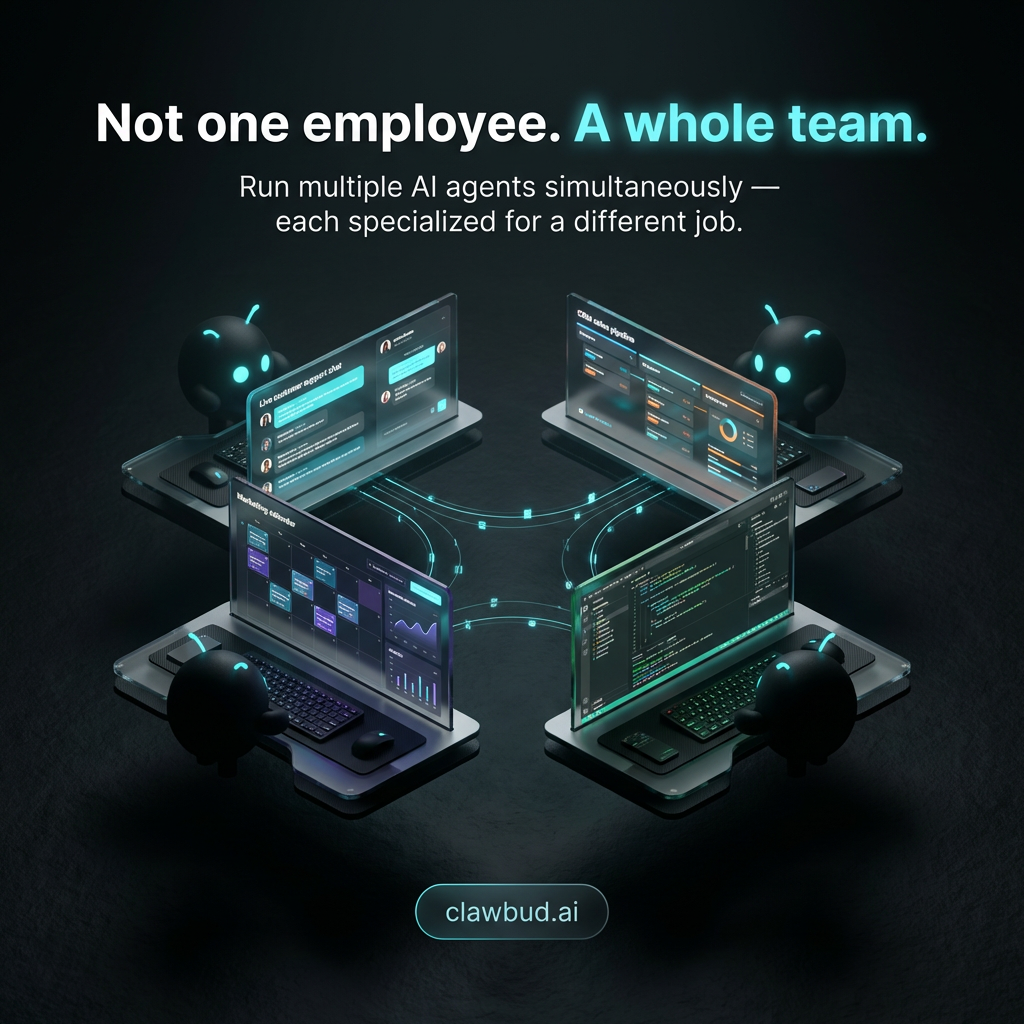
Most businesses do not need one overloaded assistant. They need specialized digital teammates.
ClawBud makes that practical by running managed OpenClaw agents on a private server, with a private cloud computer per account.
Why multi-agent beats one general agent
A single agent asked to handle support, sales ops, reporting, and technical tasks usually becomes inconsistent.
A multi-agent model creates cleaner execution:
- One agent for support
- One agent for sales operations
- One agent for internal workflow routing
- One agent for reporting and summaries
- One agent for technical tasks
Define instructions and acceptance criteria for each role, then compare the outputs in a limited test.
What ClawBud adds to OpenClaw
OpenClaw provides the framework. ClawBud provides the managed operating layer.
With ClawBud, teams get:
- Managed setup and lifecycle operations
- Private server deployment
- Clearer isolation and control
- Account-level hosting boundary
This turns OpenClaw from an experiment into a usable operating model.
Example business setup
A service business can start with 4 agents:
- Support agent handles inbound questions
- Sales ops agent qualifies and tags leads
- Scheduling agent manages follow ups
- Reporting agent summarizes pipeline and ticket status
Measure handoffs, correctness and operator time before expanding this proposed setup.
Best way to start
Use a phased rollout:
- Start with one workflow
- Deploy 3 focused agents
- Review output quality weekly
- Expand only when each new agent has a clear role
FAQ
How many agents should we start with?
Start with the few roles needed for one workflow. Add an agent only when its responsibility and access are distinct.
Is ClawBud still OpenClaw underneath?
Yes. ClawBud is built on OpenClaw and delivered as a managed private deployment.
Why does dedicated firewall matter for multi-agent?
Check shared resources and credentials before adding agents. Standard agents share the account VM, gateway, tools and provider credentials; restricted managed isolation requires approved-account access and customer API configuration.
Final takeaway
Multi-agent execution works best when each agent has one clear job.
ClawBud gives businesses a practical way to run that model with managed OpenClaw, private server isolation, and an account-level hosting boundary.