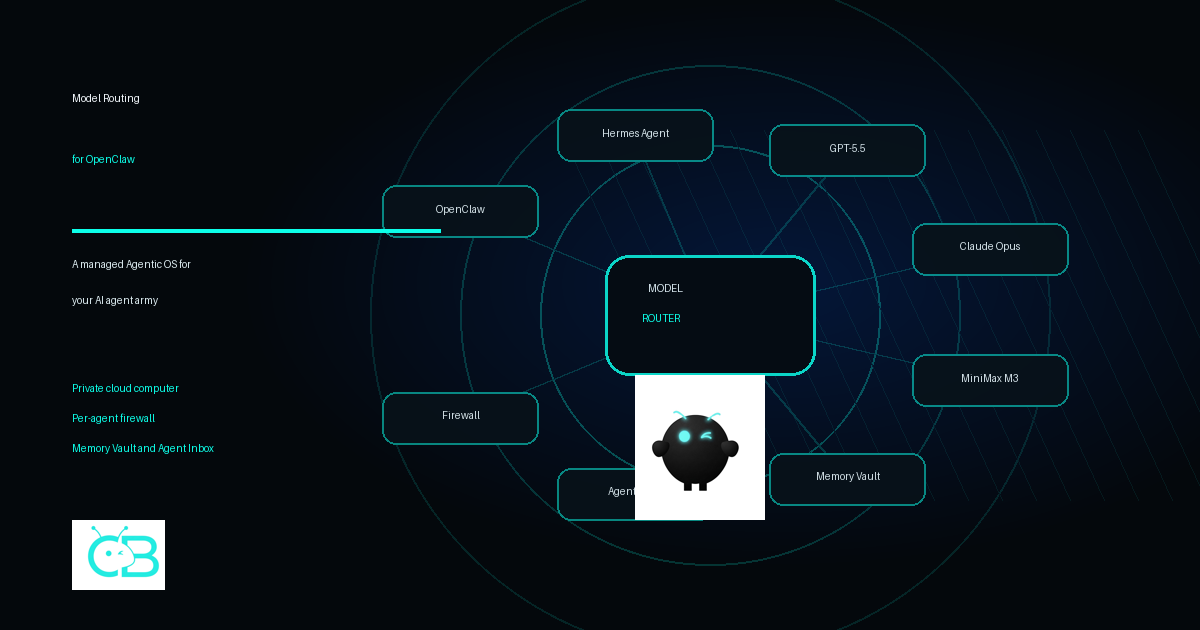
Some AI news is just benchmark theater. Claude Opus 4.7 Fast is more interesting because it points at a harder question: when you are running an OpenClaw agent army, how do you decide which model should handle which mission, and how do you stop that choice from becoming another messy spreadsheet?
That is where ClawBud is heading. ClawBud is a fully managed Agentic OS for your AI agent army, built around OpenClaw, Hermes Agent, local agents, memory, tools, approvals, and a private cloud computer that your agents can actually work inside. The model matters. The operating layer around the model matters more.
Why one model is no longer enough
For a solo chat session, picking one strong model is fine. For an agent army, it gets awkward fast.
A coding agent may need GPT-5.5 or Claude Opus for deep reasoning across a repo. A background research agent may need a cheaper model that can run often without burning money. A long-context planning agent may benefit from MiniMax M3 and its huge context window. Hermes Agent may need fast tool use, browser work, memory lookup, and clean handoffs across tasks.
If all of that lives in one generic chat window, model choice becomes a manual chore. You end up babysitting prompts instead of managing outcomes.
In ClawBud, the goal is different: give each OpenClaw agent a real workspace, then route work to the right model based on the job. The agent should know where its files are, which tools it can use, what memory it can read, what it is allowed to touch, and when it must ask for approval.
That is not just model routing. That is operating system behavior.
What Claude Opus 4.7 Fast changes
Claude Opus 4.7 Fast, as surfaced in the current OpenRouter model catalog, is part of a wider shift toward stronger flagship models with faster response profiles. The practical takeaway is simple: high-end reasoning is becoming more usable inside live workflows, not only in slow planning sessions.
For OpenClaw users, that opens a better pattern:
- Use stronger models for high-stakes reasoning, planning, writing, code review, and complex tool chains.
- Use faster or lower-cost models for routine checks, summaries, classification, and background monitoring.
- Use long-context models when the agent needs to absorb a large memory surface, docs, logs, or project history.
- Keep the agent workspace stable so the model can change without breaking the workflow.
That last point is the one most teams miss. If the Agentic OS is the product, the model can change without breaking the system.
ClawBud turns OpenClaw into a managed Agentic OS
OpenClaw is powerful because it gives agents tools, sessions, browser control, files, skills, memory, and integrations. ClawBud wraps that into a managed product for businesses that do not want to become infrastructure operators just to run an agent army.
A serious agent setup needs more than access to a model API. It needs:
- A private cloud computer for persistent agent work.
- A per-agent firewall so every worker has clear boundaries.
- OpenClaw Memory Vault for durable knowledge the agent can reuse.
- Hermes Vault for agent notes, project state, and task continuity.
- Agent Inbox for customer messages, approvals, and work queues.
- Built-in CRM and Business Room context so agents understand the business, not just the prompt.
- 1-click integrations and 1-click agent installs so setup does not turn into a weekend project.
- Agent Hub and Agent Orchestra for running multiple workers without losing control.
That stack is what makes model routing useful. Claude Opus, GPT-5.5, MiniMax M3, Hermes Agent, Codex, Claude Code, and local agents can all become part of one managed system instead of separate tabs fighting for attention.
The private cloud computer matters
AI agents are not harmless once they can browse, write files, call APIs, access customer data, and continue tasks across days. They need a place to work, and that place needs boundaries.
ClawBud gives each customer a private cloud computer for the agent army. It is dedicated, persistent, and designed for real work rather than demo sessions. The per-agent firewall adds another layer: every agent gets scoped access instead of a blank check.
That matters for model routing too. A model does not magically know what it should be allowed to do. The operating layer needs to decide which agent can access which tools, which memory, which inbox, which CRM records, and which integrations.
In plain English: the model can be brilliant and still need a locked office door.
Memory beats raw context
MiniMax M3 and other long-context models are exciting, but huge context is not the same as memory. Context is what the model sees right now. Memory is what the system can preserve, search, merge, inspect, and hand off to another agent tomorrow.
That is why ClawBud treats memory as infrastructure. OpenClaw Memory Vault and Hermes Vault are there so agents can keep working without asking the human to paste the same project brief again. Shared vault merge makes this more powerful: one agent can learn from a task, another agent can pick it up, and the business keeps the knowledge.
Long context helps. A managed memory layer keeps the army from becoming forgetful chaos with nicer model names.
Desktop, local agents, and working from everywhere
The next agent stack will not be cloud-only. Some work belongs on a private cloud computer. Some work belongs on the user's own machine. ClawBud Desktop and local agents connect those worlds so teams can continue development from everywhere: cloud OpenClaw sessions, local Codex, local Claude Code, Hermes Agent, browser work, and shared memory inside one Agentic OS.
That is why model routing needs a product layer. The best model for a local code change may not be the best model for CRM cleanup, inbox drafting, or agent-to-agent planning.
How businesses should think about model routing now
Do not ask, "Which model should we use forever?" Ask these instead:
- Which agent role needs deep reasoning?
- Which tasks need low-cost repetition?
- Which workflows require long context?
- Which tools and memories should each agent access?
- Which actions require human approval?
- Which work should happen locally, and which belongs on the private cloud computer?
Once you frame it that way, ClawBud's direction becomes obvious. The business does not need another chatbot. It needs a managed Agentic OS where OpenClaw agents, Hermes Agent, local agents, model routing, memory, CRM, inbox, and integrations work as one army.
Start with ClawBud
If you want to run OpenClaw like a serious business system, start with ClawBud. You get a managed Agentic OS for your AI agent army, running on a private cloud computer with per-agent firewall boundaries, memory, integrations, and 1-click setup.
You can also explore the ClawBud pricing page, see the main product overview, or read more on the ClawBud blog.
FAQs
What is model routing for OpenClaw agents?
Model routing means assigning different AI models to different agent tasks. A coding agent, research agent, inbox agent, and CRM agent may each need a different model based on speed, reasoning, cost, context size, and tool use.
Why does ClawBud call itself an Agentic OS?
Because ClawBud is not only a chat interface. It manages OpenClaw agents, memory, tools, files, browser work, approvals, integrations, Agent Inbox, CRM context, and agent orchestration inside one operating layer.
Does ClawBud support OpenClaw?
Yes. ClawBud is built around OpenClaw and positions it as the base layer for managed agent work. The product adds hosting, setup, memory, boundaries, integrations, and business workflow around OpenClaw.
Why use a private cloud computer for agents?
A private cloud computer gives your agent army a persistent and dedicated place to work. It helps keep files, sessions, memory, tools, and integrations organized, with per-agent firewall controls around what each worker can access.
Is Hermes Agent part of ClawBud?
Yes. Hermes Agent is a core pillar in the ClawBud agent stack, alongside OpenClaw, local agents, model routing, memory vaults, inbox workflows, and 1-click integrations.
How do I start?
Go to clawbud.ai and start with ClawBud. Choose the setup that fits your team, connect the integrations you need, and build your first OpenClaw agent army without managing the infrastructure yourself.