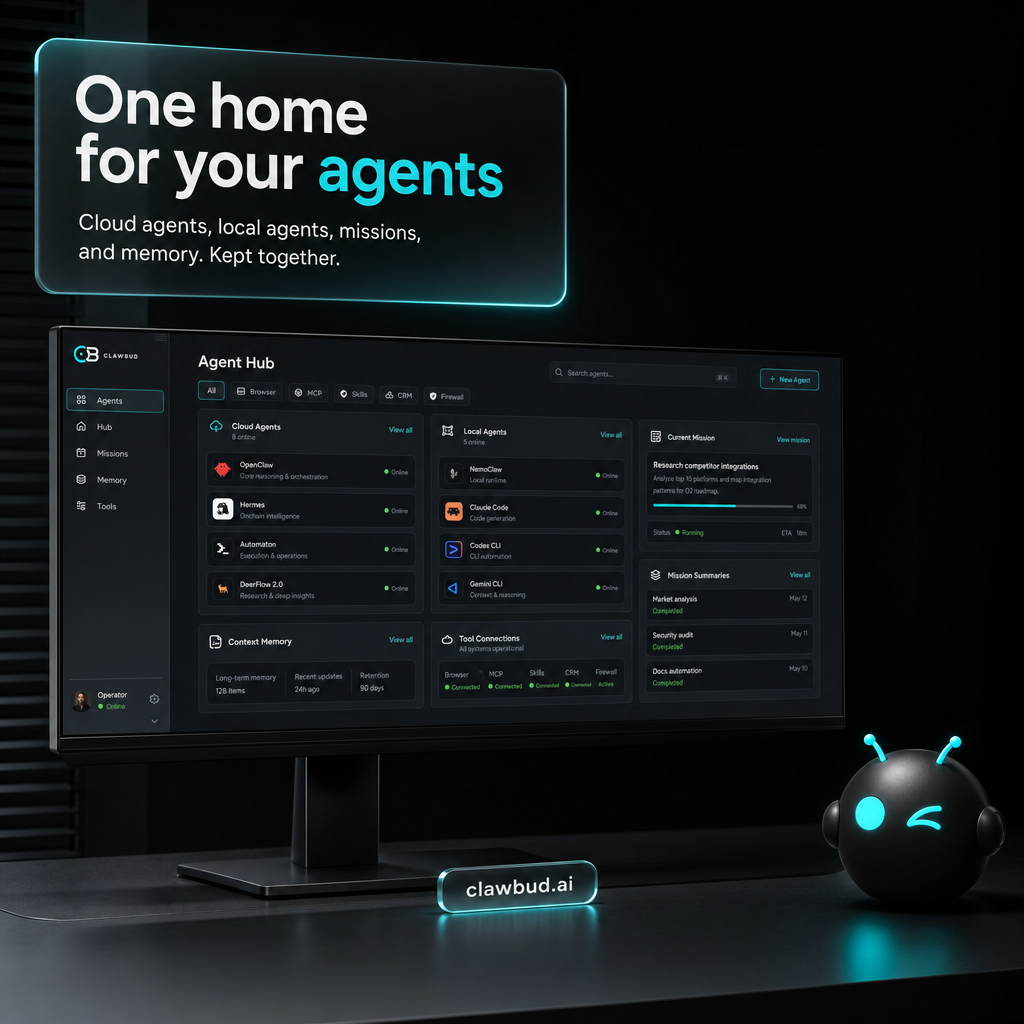
AI agents are useful when they have somewhere serious to live.
A place that remembers the mission, shows what is running, keeps local and cloud agents visible, and gives the operator enough control to trust the work. That place is Agent Hub inside ClawBud.
ClawBud is the Agentic OS for your AI agent army. Agent Hub is the part that makes that army feel organized instead of scattered across tabs, terminals, chats, scripts, cloud machines, and half forgotten task summaries.
The idea is simple: your agents should keep working after you close the laptop, and when you come back, the system should still know what happened.
Why Agent Hub matters
Most teams do not suffer from a lack of AI tools. They suffer from a lack of operating structure.
One workflow runs in a browser. Another starts from a local machine. A coding agent touches a repo. A research agent collects sources. A support agent reads customer context. A sales agent prepares follow up. A human steps away for an hour, then has to reconstruct the entire state of work from scattered logs and chat history.
That is a bad way to run an agent army.
Agent Hub gives the work one home. It brings cloud agents, local agents, mission summaries, memory, tools, and status into a single operating layer. The result is not more noise. It is less babysitting.
Cloud agents and local agents belong together
ClawBud supports the reality of how serious agent work happens.
Some work belongs in the cloud. Long running research, business automation, customer operations, content pipelines, CRM updates, inbox handling, and scheduled missions need reliable cloud runtime. They should not depend on whether a laptop is open.
Other work belongs close to the operator. Local agents can work with files, desktop context, development environments, and workflows that live near the machine. They are useful for hands on execution and personal work.
Agent Hub is the layer that keeps both worlds visible.
A cloud agent should not feel like a black box. A local agent should not feel disconnected. The operator should be able to see what is running, what finished, what needs approval, and what context matters next.
Mission summaries are not a nice extra
A good AI agent system needs memory in a practical form.
Not vague memory. Not a pile of chat transcripts. Real mission summaries.
A mission summary answers the questions that matter:
- What was the agent asked to do?
- What did it finish?
- What did it change?
- What failed?
- What evidence did it collect?
- What needs approval?
- What is the next move?
This is how agent work becomes operational. A human can step back in without rereading 400 messages. Another agent can continue the work without guessing. A manager can understand the outcome without opening every tool.
Agent Hub is built around this kind of continuity.
OpenClaw needs an operating layer
OpenClaw is powerful because it gives agents tools, skills, browser control, memory, messaging, scheduling, and a real runtime. That power becomes much more useful when it is wrapped in a managed operating environment.
ClawBud turns OpenClaw into a fully managed Agentic OS. Agent Hub is where the operator sees the army instead of thinking about setup.
The customer should not need to install packages, manage servers, debug runtimes, wire MCP tools, or maintain the fragile parts. ClawBud handles that layer and gives every customer a powerful private cloud computer with a ready AI agent army.
That matters for personal users, developers, creators, SMBs, and enterprise teams. The pattern is the same at every size: agents need a real place to work.
The Agent Hub model
Agent Hub is designed around five simple ideas.
1. Every agent has a role
An agent army works better when each agent has a clear job.
A research agent should not behave like a support agent. A coding agent should not have the same boundaries as a sales agent. Hermes, OpenClaw agents, Claude Code, Codex, Nemo Claw, Automaton, DeerFlow, and future specialized agents each make sense when the system knows what they are for.
Agent Hub gives those roles a visible structure.
2. Every mission has state
The mission is the unit of work.
A mission can be research, a customer reply, a blog draft, a code change, a CRM cleanup, a browser workflow, a lead qualification sequence, or a scheduled report. The important thing is that the system tracks the state of the mission, not just the last message.
That is how work continues cleanly.
3. Every tool has boundaries
Useful agents need tools. Safe agents need boundaries.
ClawBud is built around per agent firewall boundaries, private cloud computers, real browser access, integrations, skills, MCP, CRM, Business Room, and managed support. Agent Hub helps make those pieces understandable.
The operator should know what an agent can touch, which approvals are needed, and where the work is happening.
4. Every summary should be useful
A summary is not a decoration. It is the bridge between autonomous work and human control.
Good summaries make the system feel calm. Bad summaries create more work. Agent Hub should make it easy to understand what happened without turning the operator into a log detective.
5. The boring parts should disappear
The best infrastructure is the kind the customer does not have to think about.
The setup, runtime, cloud machine, browser, tool wiring, skills, MCP, model routing, and scheduling should be handled. The customer should see the work, the agents, the status, and the result.
That is the ClawBud philosophy in one place.
What Agent Hub makes possible
Agent Hub creates a practical foundation for real agent operations.
A founder can run research, content, outreach, product tasks, and customer follow up without losing track of the work.
A small business can keep customer support, lead handling, scheduling, inbox work, and CRM updates in one managed environment.
A developer can coordinate OpenClaw agents, Claude Code, Codex, local workflows, browser tasks, and repo related missions without spreading the system across random terminals.
An enterprise team can use dedicated private cloud computers, per agent boundaries, managed support, and operational visibility to run agent work with more control.
This is where the Agentic OS idea becomes practical. Not as a slogan. As a place where work lives.
Agent Hub and memory
Memory is one of the hardest parts of agent systems because the word is too broad.
ClawBud treats memory as operating context. It includes mission summaries, knowledge, workflow history, user preferences, files, decisions, and the state needed to continue work without starting from zero.
That is different from simply storing chat history.
For Agent Hub, memory has a job: help the agent army keep moving without making the human repeat himself.
When memory is handled correctly, the system feels simple. The chaos is hidden. The operator sees the next useful thing.
Agent Hub and the private cloud computer
ClawBud is not trying to squeeze agent work into shared containers. Each customer gets a powerful private cloud computer for their AI agent army.
That gives the system room to run real work: browsers, tools, background missions, integrations, local style workflows, secure boundaries, and long running processes.
Agent Hub sits above that private computer as the control layer. It makes the machine understandable. The user does not need to think about the machine every day. The user needs to know what the agents are doing.
Why this is bigger than a dashboard
A dashboard shows information. Agent Hub coordinates work.
That distinction matters.
The goal is not to add another screen full of metrics. The goal is to give AI agents a real operating home: roles, missions, memory, tools, approvals, summaries, and status in one managed ClawBud environment.
When done right, the product feels quieter. The user does not need to ask where the task went. The system already knows.
The practical promise
Agent Hub is built for the moment after the first demo.
The demo is easy. The real test is day two, day ten, and day one hundred. Does the agent remember the work? Can it continue? Can a human understand what happened? Can several agents work without stepping on each other? Can the system stay private, managed, and ready without turning into a DevOps project?
That is where ClawBud is focused.
ClawBud gives your AI agent army a ready Agentic OS on a private cloud computer. Agent Hub gives that army one place to live.
The work should keep moving after you close the laptop.
With Agent Hub, it can.
FAQ
What is Agent Hub in ClawBud?
Agent Hub is the ClawBud control layer for viewing and organizing cloud agents, local agents, missions, memory, summaries, tools, and status in one place.
Is Agent Hub only for businesses?
No. ClawBud is built for personal users, developers, creators, SMBs, enterprises, and organizations. The scale changes, but the need is the same: agents need a real operating home.
How does Agent Hub relate to OpenClaw?
ClawBud uses OpenClaw as a major part of the managed agent stack. Agent Hub gives operators a clearer way to manage agent work built around OpenClaw, tools, browser access, skills, memory, and missions.
Does ClawBud support local agents?
Yes. ClawBud is built around a practical mix of cloud agents and local agents. Agent Hub keeps both visible and connected to mission context.
Why are mission summaries important?
Mission summaries make agent work understandable. They show what was requested, what changed, what failed, what evidence exists, and what should happen next.
Does ClawBud run on shared containers?
No. ClawBud gives each customer a powerful private cloud computer for the agent army, with managed setup, real browser access, and per agent boundaries.
Which agents can fit into the ClawBud agent army?
ClawBud is built around OpenClaw agents, Hermes, Nemo Claw, Claude Code, Codex, Automaton, DeerFlow, browser agents, research agents, support agents, and future specialized agents.
What is the main benefit of Agent Hub?
Agent Hub reduces chaos. It gives the operator one place to see agents, missions, memory, tools, approvals, and summaries without rebuilding context every time.