SEO Title: ClawBud Model Routing Guide for OpenClaw Agent Armies
Slug: clawbud-model-routing-openclaw-agent-army
Table of Contents
- What the model routing layer does
- Why model choice matters inside an agent army
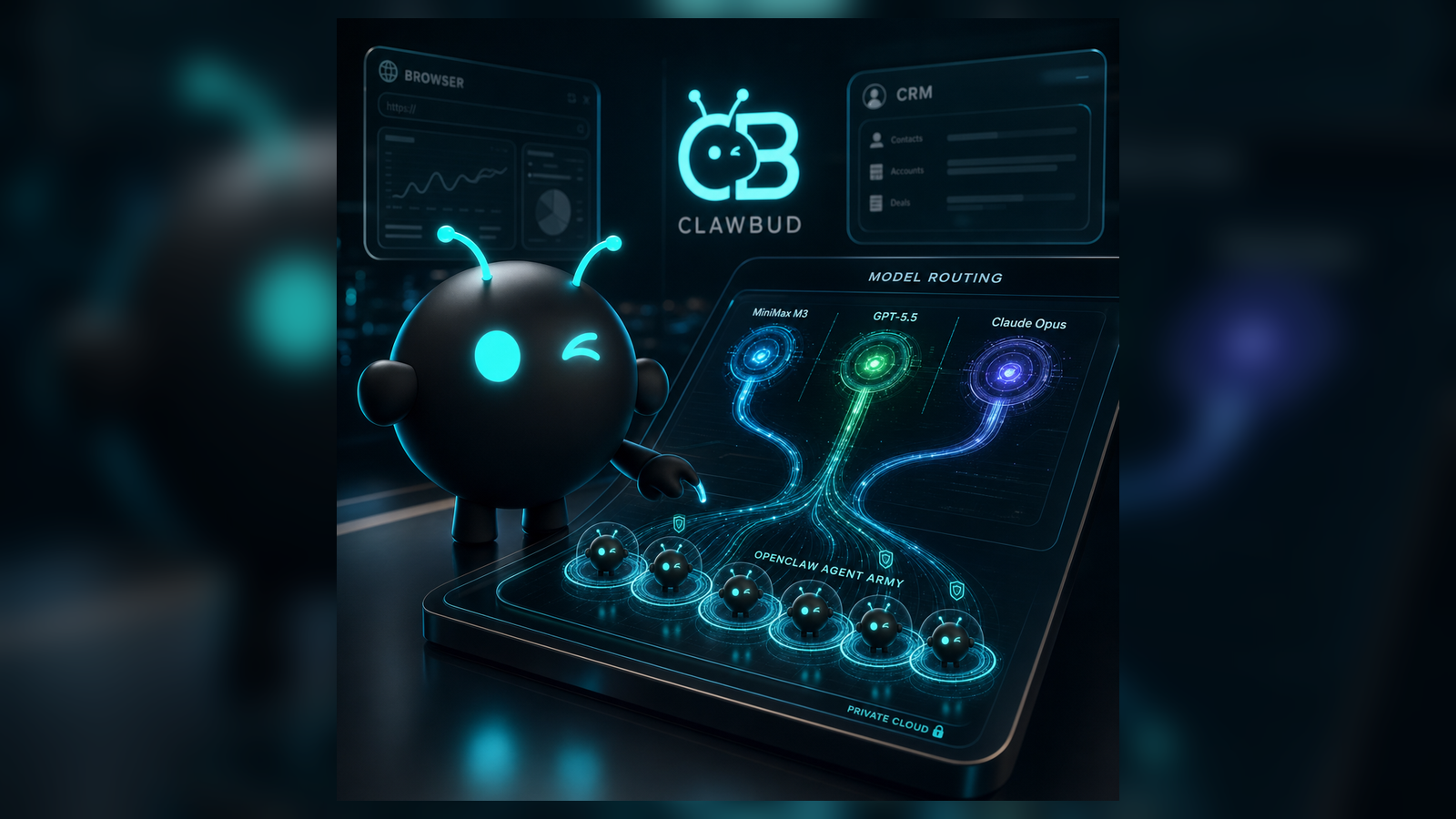
- How MiniMax M3, GPT-5.5 and Claude Opus fit
- Where Hermes Agent fits
- Who this is for
- Risks and boundaries
- Practical use cases
- FAQs
ClawBud is the fully managed Agentic OS for your AI agent army. That sounds big because it is big, but the product decision underneath it is simple: an agent army should not depend on one model for every job.
OpenClaw is the operating core. Hermes Agent is one of the pillars. Claude Code, Codex, browser agents, CRM agents and workflow agents all have different strengths. The model routing layer is the part that lets ClawBud pick the right engine for the work instead of treating every task like a chat prompt.
This guide explains how model routing fits into ClawBud, what it does for OpenClaw agents, where it helps, and where humans still need to set boundaries.
What the model routing layer does
The model routing layer is the decision layer between the mission and the model.
Instead of forcing every OpenClaw agent to use the same model for every task, ClawBud can treat model choice as part of execution. A research task may need long context. A code review may need sharper reasoning. A customer support workflow may need speed, stable tone and low cost. A Hermes Agent mission may need planning first, browser control next, then a final summary through a different model.
In a basic chatbot, the model is the product. In ClawBud, the model is one component inside a managed work system.
A good routing layer can decide based on signals like:
- Task type, such as research, coding, support, sales, ops or writing
- Context size, especially when a job includes long docs, old threads or full project history
- Tool use, including browser work, CRM updates, email drafting or file analysis
- Cost sensitivity, because not every step deserves the most expensive model
- Risk level, where sensitive work needs a safer path and clearer review
- Agent role, since Hermes Agent should not always run the same model as a lightweight inbox triage agent
The customer does not need to babysit this. ClawBud is managed so teams can start from a working OpenClaw setup without terminal work, package installs or infrastructure guesswork.
Why model choice matters inside an agent army
A single agent can survive with one model. An agent army cannot.
Once you run more than one agent, the work starts to split. One agent watches the inbox. Another handles leads. Another researches competitors. Another drafts content. Another checks code. Another uses the browser. Another manages internal tasks. If all of them use the same model all day, two things happen.
First, you overpay for simple work. A short CRM cleanup does not need the same model profile as a 60 page contract review.
Second, you underpower hard work. A long planning session with years of notes, customer history and product docs should not be squeezed into a model path built for quick replies.
Model routing fixes that mismatch.
Business owners do not care which model won a benchmark on Monday morning. They care whether the agent finishes the job without making a mess. Routing lets ClawBud build around outcomes.
This is why ClawBud is not just hosted OpenClaw. It is a managed Agentic OS around OpenClaw. Every customer gets a private cloud computer, a dedicated browser, integrations, memory, support and per-agent firewall boundaries. The model layer sits inside that system. It does not replace it.
How MiniMax M3, GPT-5.5 and Claude Opus fit
The current refreshed angle from the content intelligence brief is model routing around MiniMax M3, GPT-5.5 and Claude Opus. The duplicate risk is low compared with the topics already covered in recent ClawBud guides, so this is a clean feature to explain today.
Here is the practical split.
MiniMax M3 fits long-context work: large references, research packs, old threads and memory-heavy review. The watch-out is that long context is not the same as memory discipline.
GPT-5.5 fits broad execution: structured business tasks, production drafting and multi-step planning. The watch-out is that strong general ability still needs tool boundaries.
Claude Opus fits deep analysis: careful review, nuanced writing and complex technical judgment. The watch-out is that premium routes should be used where they matter.
MiniMax M3 is interesting because very long context changes what an agent can inspect in one pass. For an OpenClaw agent, that can mean reading more history, more files, more customer notes or more docs before acting. That is useful for audits, migrations, strategy reviews and messy business context.
But context is not memory. This is worth saying plainly. A model can hold a large pile of information and still forget what matters operationally tomorrow. That is why ClawBud pairs models with system memory, vaults, tools, workflows and agent roles. Long context helps the moment. Memory and operating structure help the business over time.
GPT-5.5 is the workhorse route for broad execution. It is a strong fit when the agent needs to reason through a task, call tools, draft a result, revise it, and hand it back in a clean format. Think sales ops, customer research, internal SOP drafting, content planning and support workflows.
Claude Opus is the premium review brain. Use it when ambiguity matters. Complex docs. Risky messaging. Technical review. Policy decisions. Product strategy. A good Agentic OS should not throw every tiny task at Claude Opus, but it should make Claude Opus available when the mission deserves that level of thought.
The point is not model fandom. The point is routing.
Where Hermes Agent fits
Hermes Agent is a core pillar in ClawBud because agent armies need a strong operator, not only a chat window. Hermes can plan, coordinate work, interact with the environment and help drive longer missions. In many setups, Hermes is the agent you want when the job has steps, tools and a need for judgment.
Model routing makes Hermes better because Hermes does not need to be tied to one model identity forever. One Hermes mission might use MiniMax M3 to digest a large knowledge pack, then GPT-5.5 to build an action plan, then Claude Opus to review a sensitive final recommendation. Another mission might stay on a faster route because the work is simple.
That is the right mental model: Hermes is the operator, OpenClaw is the agent framework, ClawBud is the managed Agentic OS, and the model routing layer chooses the right engine for each stage of work.
This is also why ClawBud keeps talking about an agent army, not a single assistant. A business does not need one clever bot in a corner. It needs coordinated workers with roles, tools, memory and boundaries.
Who this is for
This feature is for teams that already know one AI chat tab is not enough.
It is for founders who want agents to handle real operating work across inboxes, CRM, research, support and content. It is for agencies that need repeatable client workflows without rebuilding agent infrastructure every week. It is for technical teams that want OpenClaw power without owning the whole setup burden. It is for small businesses that want a private cloud computer where their AI agent army can run 24/7 with managed support.
It is also for teams that care about cost control. Model routing is not only about quality. It is about not spending premium model money on cheap tasks. Good routing lets a team save the expensive brainpower for the work that actually needs it.
Most of all, it is for teams that want OpenClaw in production without turning into accidental DevOps people.
ClawBud gives you the managed base: OpenClaw, private cloud computer, dedicated browser, integrations, support, per-agent firewall boundaries, and the Agentic OS layer around the army.
Risks and boundaries
Model routing is powerful, but it is not magic.
The first risk is assuming the largest context window solves memory. It does not. Long context can help an agent read more at once, but business memory still needs structure: what to save, what to forget, what to treat as source of truth, and what requires approval.
The second risk is silent escalation. If a system routes every hard task to the most expensive model without visibility, costs can creep. ClawBud should treat routing as a managed feature, not a black box that surprises customers.
The third risk is over-automation. Some jobs should still ask for approval. Sending a sensitive customer email, changing a payment workflow, contacting a lead from a cold list, or publishing public content should have review gates unless the business explicitly approves automation.
The fourth risk is tool access. A stronger model with messy permissions is still dangerous. That is why ClawBud cares about per-agent firewall boundaries, integration scopes, private cloud computers and agent roles. The safety layer is not an afterthought. It is part of making agent armies usable in real businesses.
The right boundary is simple: let agents do the work they are trusted to do, route them to the model that fits, and keep approval gates around actions that can affect customers, money, reputation or infrastructure.
Practical use cases
1. Long customer history review before a sales call
A sales agent can pull CRM notes, email history, old proposals, support tickets and meeting summaries into one mission. MiniMax M3 can help with the large reference load. GPT-5.5 can turn the findings into a clean call brief. Claude Opus can review the final recommendation if the deal is high value.
Inside ClawBud, this fits naturally with OpenClaw Memory Vault, built-in CRM and the private cloud computer where the agent can run the workflow without juggling five separate tools.
The result is not a generic account summary. It is a useful sales brief: what changed, what the customer cares about, what risk exists, what to ask next, and what not to say.
2. Technical research and product planning
A product team can ask an OpenClaw agent to inspect docs, competitor pages, GitHub notes, customer feedback and internal roadmap material. The routing layer can use long context for intake, stronger reasoning for synthesis, and premium review for final decisions.
Hermes Agent is especially useful here because the job is not one prompt. It is a mission: collect evidence, compare options, create a plan, check assumptions, then produce a decision memo.
This is where ClawBud starts to feel less like software and more like a staff layer. The agents do the boring reading. Humans make the call.
3. Support operations with smart escalation
A support agent can triage incoming messages from Telegram, WhatsApp, Discord, Slack or email. Simple questions can run on a faster model route. Messy issues can escalate to GPT-5.5. Sensitive or high-risk replies can move to Claude Opus for review before a human approves.
That matters because support work has different weights. A password reset instruction is not the same as a frustrated enterprise customer asking why a workflow failed.
ClawBud gives the agent army the environment to handle this properly: OpenClaw tools, integrations, memory, private cloud computer, dedicated browser and managed support when the agent itself needs help.
How this fits into the ClawBud agent army
Think of model routing as the dispatch board for thinking. Hermes Agent can coordinate complex missions. OpenClaw agents can handle chat, browser work, research, CRM updates and operational tasks. Claude Code and Codex can support engineering workflows. Business Room can turn company context into action. The CRM keeps customers, deals and tasks grounded.
Routing makes that army more efficient. Simple work stays simple. Hard work gets the model depth it needs. ClawBud can add new routes over time without forcing customers to rebuild their setup.
Bottom line
Model routing is one of those features that sounds technical until you see what it does for daily work.
It means your OpenClaw agent army can use MiniMax M3 when the mission needs a huge reference window, GPT-5.5 when it needs strong general execution, and Claude Opus when the work needs careful judgment. Hermes Agent can coordinate the mission. ClawBud manages the operating layer around it.
That is the difference between playing with AI and running an AI workforce.
If you want a managed OpenClaw agent army on a private cloud computer, with a dedicated browser, integrations, memory, support and per-agent firewall boundaries, start with ClawBud.
FAQs
1. What is ClawBud model routing?
ClawBud model routing is the layer that matches an agent mission with the right model path. Instead of forcing every OpenClaw agent to use one model for every task, ClawBud can route work based on context size, task type, risk and cost.
2. Does ClawBud replace OpenClaw?
No. ClawBud is built around OpenClaw. It gives OpenClaw a fully managed Agentic OS, private cloud computer, integrations, browser access, support, memory and security boundaries so businesses can run an agent army without managing the setup themselves.
3. Why would an agent use MiniMax M3?
MiniMax M3 is useful when a mission needs very long context, such as large research packs, customer histories, long docs or big project reviews. It helps the agent inspect more information in one pass, but it still needs memory structure and approval rules.
4. Where does GPT-5.5 fit?
GPT-5.5 is a strong general route for multi-step business work. It fits planning, drafting, research synthesis, workflow design and operational tasks where the agent needs reliable reasoning and clean execution.
5. Where does Claude Opus fit?
Claude Opus is a strong fit for deep analysis, careful writing, sensitive review and complex technical judgment. In ClawBud, it should be used where quality and caution matter more than raw speed.
6. Is Hermes Agent still important if models keep changing?
Yes. Hermes Agent is a core pillar because it acts as an operator for longer missions. Model routing gives Hermes better engines for different stages of work, but Hermes still provides mission structure, tool use and coordination.
7. Can model routing reduce AI costs?
Yes, when it is managed well. Simple tasks can use lighter or faster routes while harder work gets premium models. The goal is to spend model budget where it actually improves the outcome.
8. Is this safe for business use?
It can be, if the agent has clear boundaries. ClawBud combines OpenClaw with private cloud computers, per-agent firewall boundaries, scoped integrations, support and approval gates for sensitive actions. Strong models still need operating rules.
9. How do I start?
Go to clawbud.ai, choose the plan that fits your usage, and start with a managed OpenClaw agent army on a private cloud computer. You do not need terminal knowledge to begin.