The AI agent market is quietly moving past the cute demo phase.
A year ago, the pitch was simple: type a prompt, watch an agent do something impressive, share the screenshot. That was fun. It also broke down the second the task needed memory, context, handoffs, files, approvals, browser work, email, or a way to continue tomorrow without starting from zero.
The current signal from the developer world is different. GitHub is pushing custom agents in Copilot CLI from one off prompts into repeatable workflows. The direction is obvious: agents are not just prompt boxes anymore. They are becoming workers with repeatable jobs.
That is exactly where OpenClaw gets interesting, and why ClawBud exists.
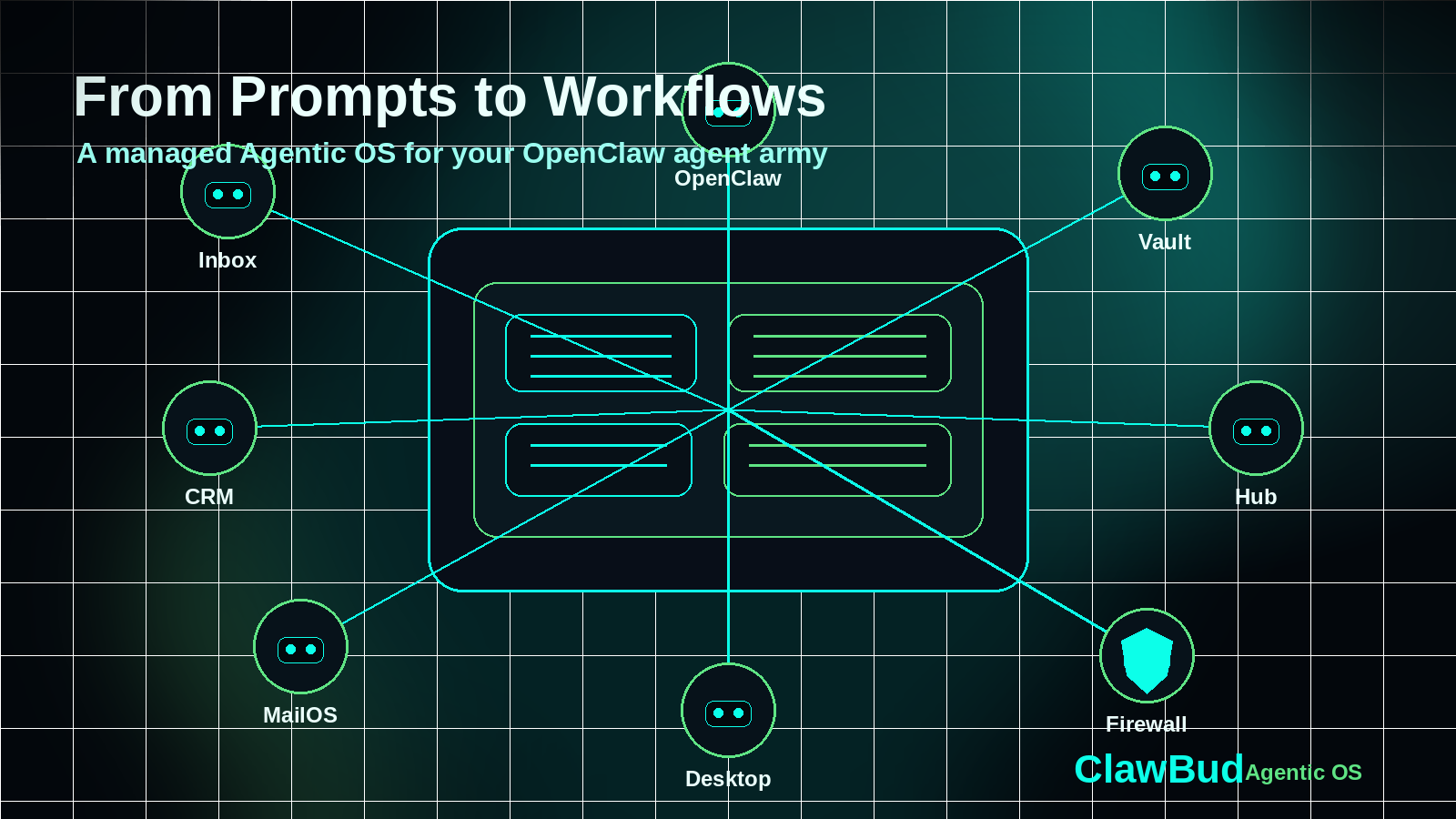
ClawBud is the fully managed Agentic OS for your AI agent army. It gives OpenClaw, Hermes Agent, local agents, coding agents, browser agents, inbox agents, and business agents a real operating layer on a private cloud computer. Not another chatbot tab. A place where agents can work, remember, connect, ask for approval, and stay inside clear boundaries.
The prompt era was useful, but it was never enough
Prompts are great for one clean task.
Write this paragraph. Summarize this page. Generate a SQL query. Explain this bug.
Workflows are different. A workflow has state. It has tools. It has someone waiting for the result. It might touch a customer inbox, a GitHub issue, a CRM record, a spreadsheet, a browser session, or a local development environment.
That shift changes the infrastructure problem.
An agent that only answers questions can live inside a chat window. An agent that runs business work needs a home. It needs memory, files, logs, a browser, integrations, permission boundaries, and a way to hand work to another agent without losing the plot.
This is why “just give me a better model” is starting to feel thin. GPT-5.5, Claude Opus, MiniMax M3, and other frontier models matter, but raw intelligence is not the same as operational reliability.
A brilliant agent with no workspace is still a freelancer with amnesia.
OpenClaw needs an operating layer, not more glue code
OpenClaw already gives serious users a powerful base for running AI agents. The problem is what happens around it.
Most teams eventually bolt together a messy pile of scripts, browser sessions, credentials, notes, terminals, MCP servers, approval messages, and half documented workflows. It works until it does not. Then nobody knows what the agent saw, where the task stopped, which tool it used, or whether it is safe to let it continue.
ClawBud wraps OpenClaw with the missing operating layer.
That means:
- A private cloud computer for persistent agent work
- A per-agent firewall so each agent has clear boundaries
- OpenClaw Memory Vault and Hermes Vault for durable knowledge
- Agent Inbox, MailOS, and built-in CRM context
- Agent Hub for managing the agent army in one place
- 1-click integrations and 1-click agent installs
- Desktop app continuity so work can continue from everywhere
This is the boring part that makes the exciting part useful.
Local agents and cloud agents should not live in separate worlds
One of the more important trends right now is the return of local agents.
Developers want Codex, Claude Code, local terminals, language servers, and project context close to the codebase. That makes sense. Some work belongs on your machine. It needs local files, local speed, local developer habits, and real editor context.
But business workflows do not stop at the laptop.
The agent also needs long running memory, a shared vault, scheduled work, browser access, communication tools, CRM context, and a safe place to keep going when the local session is closed. That belongs in a managed environment.
ClawBud’s view is simple: local agents and cloud agents should cooperate, not compete.
The desktop app gives users a way to continue development from everywhere while keeping the wider OpenClaw workspace alive. A coding agent can handle the repo. Hermes Agent can handle research, browser work, operational tasks, and larger agent workflows. OpenClaw can coordinate the workspace. The shared vault merge keeps knowledge from getting trapped in one session.
That is the shape of the next serious agent stack: local where it should be local, managed where it must be reliable.
Memory is the difference between a demo and a worker
Context windows are getting bigger. That is useful. MiniMax M3 and other large context models make it easier to load more material into a single run.
Still, context is not memory.
Context is what the model sees right now. Memory is what the system knows, preserves, edits, merges, and reuses over time. A business cannot depend on agents that relearn the same company facts every morning.
OpenClaw Memory Vault and Hermes Vault are ClawBud’s answer to that problem. They turn agent knowledge into a managed layer instead of a pile of pasted notes. The goal is stable company context, past decisions, customer details, product rules, and team preferences without asking humans to repeat themselves forever.
For an AI agent army, memory is not a feature checkbox. It is infrastructure.
The dedicated firewall matters more as agents get useful
The more capable agents become, the less comfortable it is to run them in a shared, vague, poorly bounded environment.
An agent that reads docs is low risk. An agent that opens a browser, connects to tools, drafts emails, changes files, manages leads, or coordinates other agents needs boundaries.
That is why ClawBud builds around a private cloud computer and per-agent firewall controls. Each agent should have the access it needs, not a magical skeleton key to the whole business.
This matters for OpenClaw because OpenClaw is not a toy. Once it becomes part of real work, isolation and permission design stop being security theater. They become product quality.
A managed Agentic OS should make the safe path the default path.
Start with OpenClaw, then give it a real workplace
If you already understand OpenClaw, the next question is not “Can I run an agent?”
The better question is: where does the agent live, what does it remember, which tools can it touch, how does it ask for approval, and how do other agents join the mission?
ClawBud is built for that layer. It brings OpenClaw into a managed Agentic OS with a private cloud computer, dedicated firewall boundaries, memory vaults, agent inbox, MailOS, CRM, Agent Hub, and 1-click integrations.
If your AI work is still prompt by prompt, this may sound like a lot.
If you have already watched agents lose context, repeat work, or get stuck between tools, it probably sounds overdue.
Explore ClawBud, read more about what ClawBud is, compare the OpenClaw agent setup, and see how 1-click skills and MCP fit into the agent army model.
Ready to stop managing scattered agent experiments? Start with ClawBud and give your OpenClaw agent army a managed OS.
FAQs
What is ClawBud?
ClawBud is a fully managed Agentic OS for running an AI agent army. It gives OpenClaw and related agents a private cloud computer, memory, browser access, inbox workflows, integrations, and permission boundaries.
How is ClawBud different from only using OpenClaw?
OpenClaw is the agent foundation. ClawBud adds the managed operating layer around it: setup, hosting, memory vaults, Agent Inbox, MailOS, CRM context, Agent Hub, 1-click integrations, and per-agent firewall controls.
Does ClawBud support Hermes Agent?
Yes. Hermes Agent is one of the core pillars in the ClawBud agent stack. It works alongside OpenClaw and other agents as part of the managed Agentic OS.
Why does an AI agent need a private cloud computer?
A serious agent needs a persistent workspace for files, browser sessions, memory, tools, logs, and long running tasks. A private cloud computer gives the agent a dedicated place to work instead of relying on scattered sessions.
What is the OpenClaw Memory Vault?
OpenClaw Memory Vault is ClawBud’s durable knowledge layer for OpenClaw workspaces. It helps agents reuse company context, decisions, preferences, and workflow knowledge across missions.
Can ClawBud work with local agents?
Yes. ClawBud is designed for a world where local agents and managed cloud agents cooperate. Local agents can stay close to the codebase while ClawBud keeps the wider workspace, memory, approvals, and agent coordination alive.