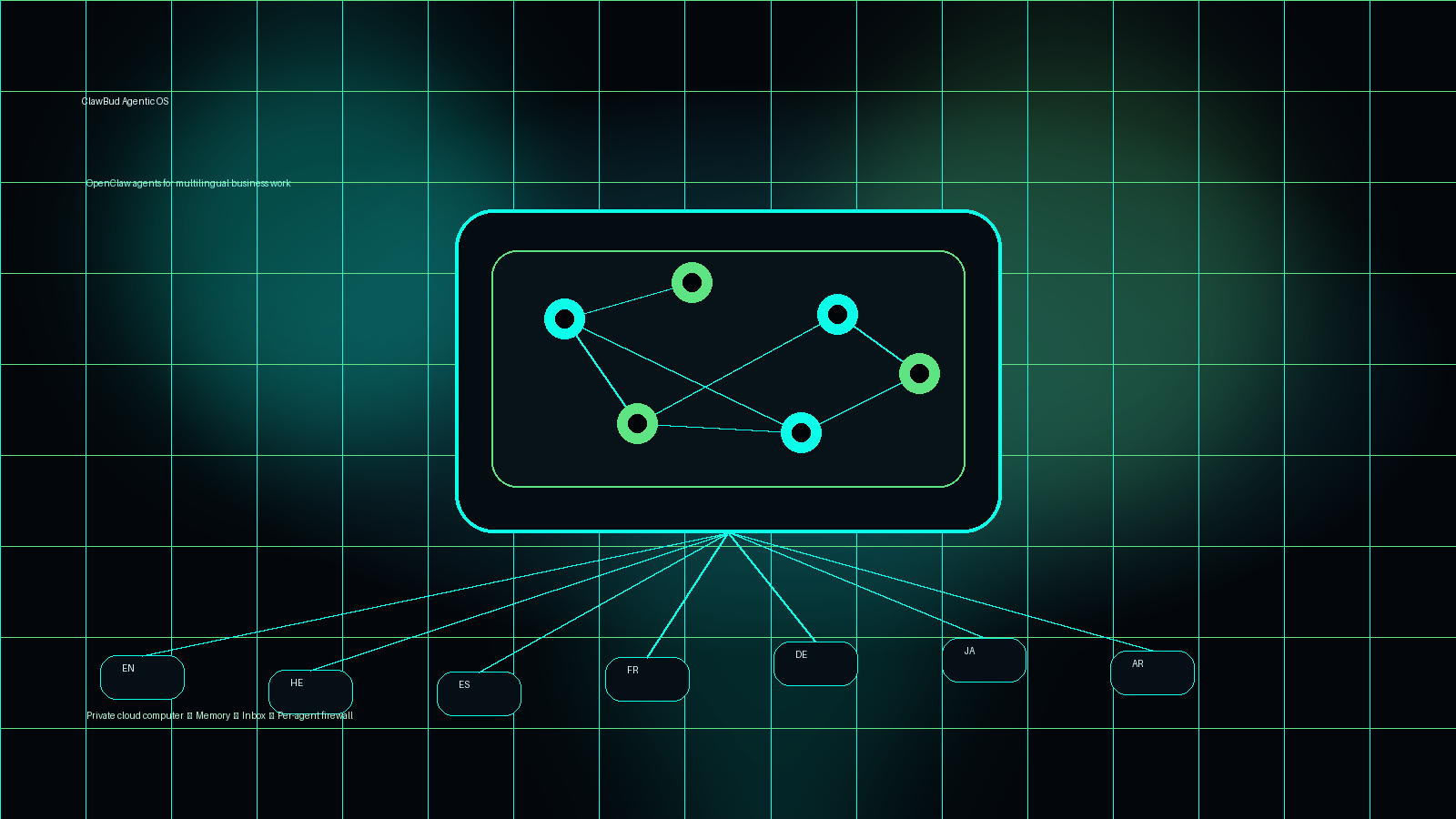
AI agents are about to get a lot more multilingual.
Google DeepMind’s recent work on Gemini 3.5 Live Translate is a signal that language barriers are becoming part of the agent infrastructure problem. The obvious use case is live conversation. The bigger one is business operations: inboxes, support threads, sales calls, research, approvals, and customer handoffs moving across languages all day.
That is where OpenClaw becomes interesting, and where ClawBud has a clear job.
ClawBud is the fully managed Agentic OS for your AI agent army. It gives OpenClaw, Hermes Agent, local agents, browser agents, inbox agents, and coding agents a persistent workspace on a private cloud computer, with memory, approvals, tools, integrations, and per-agent firewall boundaries. If AI agents are going to translate, understand, and act across languages, they need more than a clever model. They need an operating layer.
Translation is not just a feature anymore
Live translation used to feel like a user interface feature. Useful, impressive, but mostly attached to calls and captions.
For agentic work, translation is different.
An AI agent that helps a company sell, support, research, hire, build, and operate cannot treat language as a side quest. It may need to read a supplier email, summarize a customer complaint, compare policy pages, draft a reply in the customer’s language, then ask a human for approval before anything is sent.
That is not one prompt. That is a workflow.
And workflows need structure: memory, inbox context, browser research, model routing, permissions, approvals, and a place to store what happened.
Translation is becoming one more capability inside that stack. The winners will not be teams with the fanciest demo. The winners will be teams whose agents can safely use translation inside real work.
OpenClaw is powerful, but global work needs a home
OpenClaw gives serious users a strong base for running agents. It can connect tools, run browser work, manage files, use memory, and handle long tasks better than a normal chat window.
But global business work adds pressure.
If an OpenClaw agent reads multilingual customer history, pulls context from a CRM, drafts a response, checks product rules, and waits for a manager’s approval, the company needs to know where that work lives. It needs continuity. It needs logs. It needs boundaries. It needs memory that does not disappear when the tab closes.
That is the ClawBud layer.
ClawBud wraps OpenClaw in a managed Agentic OS so the agent army has a proper operating environment. Not a scattered pile of prompts, notes, browser tabs, and scripts. A full computer for agent work, managed so teams can focus on outcomes instead of wiring plumbing every week.
The multilingual agent army needs memory, not just context
Bigger context windows help. Better translation models help. MiniMax M3, GPT-5.5, Claude Opus, Gemini models, and other frontier systems all matter.
But context is what an agent sees right now. Memory is what the business needs the agent to know tomorrow.
A multilingual agent needs durable knowledge: language preferences, approved support tone, product rules, past decisions, sensitive terms, and tasks that require approval before sending.
OpenClaw Memory Vault and Hermes Vault are built for this kind of persistent knowledge. They give agents a shared place to preserve facts, decisions, working notes, and reusable context. Shared vault merge makes that even more important, because local agents and cloud agents should not create separate versions of company memory.
Agent Inbox and MailOS turn language into operations
The biggest practical impact of live translation will not be flashy demo calls. It will be the inbox.
Every business already runs on messages. Leads ask questions. Customers complain. Partners send documents. Suppliers confirm pricing. Internal teams ask for updates. Most of that work is language heavy, context heavy, and approval heavy.
This is why Agent Inbox and MailOS matter inside ClawBud.
An inbox agent should be able to understand the message, identify the customer, pull memory, draft the reply, route it to the right human, and wait. If translation is needed, it should happen inside the same workflow, not in a separate tool that loses context.
The safe pattern is simple: the agent reads the message, OpenClaw checks memory and CRM context, the right model handles translation or drafting, Hermes Agent or another worker prepares the next step, a human approves, and the final action is logged.
Local plus managed beats local versus cloud
Some work belongs close to the user’s machine. Local agents are great when they need files, code, editor context, or fast iteration. But a business agent army also needs work that keeps running when the laptop is closed. It needs a managed OpenClaw workspace, a private cloud computer, shared vaults, browser access, scheduled tasks, integrations, and a way to continue development from everywhere.
The right architecture is local plus managed.
A local coding agent can work on the repo. A cloud OpenClaw agent can research the market. Hermes Agent can coordinate browser and operational work. An inbox agent can prepare customer replies. Agent Hub can keep the army visible. Business Room can give the team one place to understand what is happening.
That is the point of an Agentic OS. It is the system where specialized agents can cooperate without losing context or breaking boundaries.
Permissions matter more when agents understand more
Translation sounds harmless until the agent can act.
Once agents can read messages, access business context, draft replies, browse the web, call integrations, and update records, each agent needs a clear boundary. A support agent should not get the same permissions as a finance agent. A research agent should not be able to send customer emails. A local coding agent should not inherit access to every business inbox by accident.
ClawBud’s per-agent firewall is the practical answer. Each agent gets the right scope for its job. The private cloud computer becomes a controlled workspace, not a free for all.
What this means for businesses adopting AI agents
Gemini 3.5 Live Translate is a useful trend signal because it points toward a wider reality: AI work is becoming global, live, and operational.
The next generation of AI agents will not only answer questions. They will coordinate work across languages, tools, teams, customers, and systems. For that to be useful, businesses need a managed layer around the agents.
ClawBud is building that layer for OpenClaw.
With 1-click integrations, 1-click agent installs, Agent Inbox, MailOS, built-in CRM, OpenClaw Memory Vault, Hermes Vault, Agent Hub, ClawPet, Business Room, Agent Orchestra, local agents, and model routing across MiniMax M3, GPT-5.5, Claude Opus, and Gemini, ClawBud turns agent work into something a team can actually run.
The takeaway is simple: multilingual AI is not just about understanding more words. It is about giving agents a safe place to act on that understanding.
If your company is ready to move past isolated AI chats, start with ClawBud and build your OpenClaw agent army on a managed Agentic OS.
FAQ
What is a managed Agentic OS?
A managed Agentic OS is the operating layer for AI agents. In ClawBud, it includes OpenClaw, memory, files, browser work, integrations, approvals, inbox workflows, local agents, model routing, and security boundaries on a private cloud computer.
Why does OpenClaw need ClawBud?
OpenClaw is powerful, but teams still need a managed environment around it. ClawBud gives OpenClaw agents persistent memory, shared tools, Agent Inbox, MailOS, Agent Hub, per-agent firewall controls, and 1-click setup.
How does live translation affect AI agents?
Live translation makes agents more useful across customer support, sales, research, hiring, and operations. The key is connecting translation to memory, approvals, CRM context, and safe action.
What is the role of Hermes Agent in ClawBud?
Hermes Agent is a core pillar in the ClawBud agent army. It helps with operational tasks, browser work, research, tool use, and workflows that need more than a simple coding assistant.