How do you build an AI agent army without DevOps?
· ClawBud editorial team
Updated September 7, 2026
By ClawBud
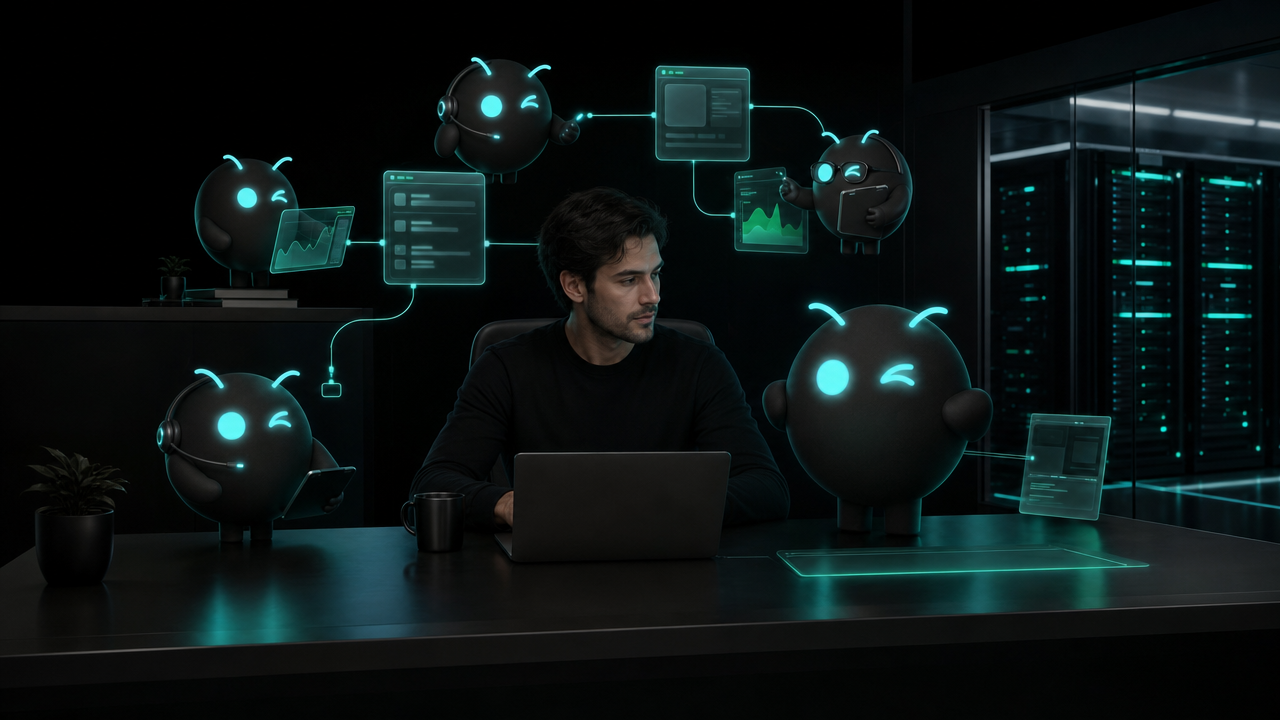
Build an AI agent army without DevOps by choosing a managed runtime, defining one job per agent, connecting only the tools each job needs, and testing every workflow before granting write access. The managed provider should own installation, updates, gateway availability, backups, and recovery. Your team should still own business rules, permissions, approvals, and the definition of a successful result.
Quick answer. Start with two or three agents, not twenty. Give each agent a named job, private workspace, narrow credentials, an approved trigger, and a clear handoff. Choose ClawBud when you want managed OpenClaw and the operating layer on a private cloud computer. Choose self-hosting when your engineers must control the host and already operate production infrastructure.
What does “without DevOps” actually mean?
DevOps is the work required to deploy, secure, update, observe, and recover software in production. “Without DevOps” does not mean those jobs disappear. It means a managed provider owns the runtime work while the buyer owns the business process and permission decisions.
OpenClaw can be installed directly, with Docker, or through supported platform paths. Its Gateway is the long-running control service for agents, channels, tools, and sessions. A self-hosted team therefore owns the host, Gateway process, dependencies, upgrades, credentials, logs, and recovery path. OpenClaw installation documentation OpenClaw Gateway documentation
Which operating model should you choose?
Use these criteria before choosing a product: runtime ownership, setup burden, privacy boundary, tool control, recovery responsibility, integration work, and the level of infrastructure control your team requires.
| Option | Best fit | Setup burden | Ongoing management | Privacy or security | Integrations | Main limitation |
|---|---|---|---|---|---|---|
| Managed Agentic OS | Teams that want agents working without operating the stack | Low | Provider owns runtime operations; buyer owns policies and workflows | Ask whether the environment is private and how credentials are scoped | Provider-supported channels, skills, MCP, browser, and tools | Less host-level control than self-hosting |
| Managed OpenClaw hosting | Teams that want OpenClaw deployed and maintained | Low to medium | Provider scope varies, so verify updates, monitoring, and recovery | Depends on deployment model and provider controls | Often starts with OpenClaw channels and extensions | “Managed” may cover the server but not the whole agent workflow |
| Self-hosted OpenClaw | Engineering teams that require complete host control | High | Your team owns deployment, updates, observability, secrets, and incidents | Maximum configuration control, with matching responsibility | Flexible, subject to your integration work | Requires real operating capacity |
| Local experiment | One developer proving a narrow workflow | Low at first | Developer owns everything | Data stays within the chosen local setup, subject to connected services | Good for testing | A laptop is not a reliable production runtime |
Conditional recommendation: choose a managed Agentic OS when the goal is useful multi-agent work with minimal infrastructure ownership. Choose managed hosting when OpenClaw deployment is the main problem. Choose self-hosting when host control is mandatory and the team can support it.
How do you design the first agent team?
Start with a workflow that already has a clear owner and a measurable finish line. A useful first team might include a research agent that gathers approved sources, an operations agent that updates a named system, and a reviewer that checks the proposed action before it reaches a customer.
Write an operating card for each agent:
- Name the job and the outcome it owns.
- List the people or systems allowed to trigger it.
- List the exact data it may read.
- List the actions it may take without approval.
- Put payments, deletion, public publishing, credential changes, and sensitive customer contact behind approval.
- Define where work is handed off and how success is verified.
The point is separation. Five copies of the same broadly privileged agent are not an army. They are one security problem with matching uniforms.
How do you build it without managing servers?
1. Choose the runtime owner
Ask who handles the initial installation, Gateway availability, dependency updates, operating system patches, backup policy, monitoring, and incident recovery. Get the answer in writing. OpenClaw's own documentation treats installation and the Gateway as distinct operational concerns, which is a useful warning against confusing “installed” with “production-ready.” OpenClaw installation documentation OpenClaw Gateway documentation
2. Create one private workspace per responsibility
Keep agent instructions, working files, and credentials separated where the platform supports it. Shared context should be deliberate. An agent that prepares invoices does not need the publishing agent's social credentials.
3. Add instructions before adding tools
OpenClaw skills package repeatable instructions in a SKILL.md file. Install only the skills needed for the selected workflow, review their scripts and dependencies, then verify eligibility in a clean session. OpenClaw skills documentation
4. Connect the smallest useful tool set
Use native integrations or MCP servers for live capabilities. MCP can expose tools and resources from another program, but every connection expands the systems an agent can reach. Start with read access, restrict the exposed tool list, and test one harmless operation. OpenClaw MCP documentation
5. Store secrets outside prompts and files
Use the runtime's supported secret or credential mechanism. Do not paste API keys into agent instructions, chat history, committed configuration, or shared documents. Rotate any credential that leaks into those places. OpenClaw secrets documentation
6. Add approval and recovery rules
Decide which actions may run automatically, which need a human, and what happens after an uncertain result. A timeout does not prove an outside service rejected the request. Check for partial completion before retrying actions that can send, publish, pay, delete, or create duplicate records.
7. Verify one complete mission
Run the workflow with test data from trigger to final check. Confirm the correct agent received it, every tool call stayed within scope, the expected record changed once, the handoff was visible, and a failed step produced a recoverable state.
What should you verify before production?
| Check | Pass condition | Failure response |
|---|---|---|
| Runtime | Gateway and required services recover after interruption | Stop launch and confirm provider recovery ownership |
| Identity | Only approved people and channels can trigger the agent | Narrow authentication and channel access |
| Permissions | Agent can complete its job but cannot reach unrelated systems | Remove broad credentials and unused tools |
| Secrets | No credential appears in prompts, files, logs, or source control | Revoke, rotate, and move it to supported secret storage |
| Workflow | One test mission produces one verified result | Add checkpoints and external completion checks |
| Approval | Sensitive actions pause for the named reviewer | Block the action until the approval path works |
| Handoff | Humans and other agents can see status and ownership | Add a shared mission record or queue |
Do not call the system production-ready because the agents answered a chat message. Verify the work, the boundary, and the recovery path.
Where does ClawBud fit?
ClawBud is the fully managed Agentic OS for an AI agent army, including managed OpenClaw on a private cloud computer. It fits teams that want the runtime, browser, integrations, skills, MCP connections, agent coordination, and routine operating work handled as one environment. Current packaging and included capabilities should be checked on the ClawBud pricing page.
ClawBud is not the right fit when your security or platform team must own the host inside its own cloud account, select every package, control the complete network policy, and run the incident process. Self-hosted OpenClaw is the cleaner choice for that requirement.
What are the limits of a no-DevOps approach?
A managed platform removes infrastructure work from the buyer, not accountability. Someone in the business still has to define correct behavior, approve sensitive actions, review exceptions, and decide what data each agent may use. Provider support also cannot make an unsafe third-party tool trustworthy or turn an unclear process into a reliable workflow.
Frequently asked questions
How many agents should I start with?
Start with two or three agents around one real workflow. That is enough to test role separation, handoffs, tool permissions, and review without creating an orchestration puzzle. Add another agent only when it owns a distinct outcome or removes a clear bottleneck. Agent count is a design choice, not a success metric.
Do I need Kubernetes or Docker to run an agent army?
Not when a managed provider owns the runtime. A self-hosted team may choose Docker or another deployment method, but the container is only one part of production operation. Updates, credentials, Gateway availability, monitoring, backups, and recovery still need owners. Choose the simplest deployment model that meets your control requirements.
Can one OpenClaw instance run several agents?
OpenClaw supports agent and session concepts, but the safe production shape depends on the required isolation, tools, credentials, and provider architecture. Do not assume that several named agents automatically have separate security boundaries. Verify workspace, credential, network, and execution isolation for the platform you select. OpenClaw Gateway documentation
What should remain under human approval?
Keep irreversible or high-impact actions behind approval: payments, deletion, credential changes, public publishing, legal commitments, broad data exports, and sensitive customer messages. Low-risk, reversible internal actions can become automatic after testing. The approval line should follow potential harm, not how confident the model sounds.
How do agents share context safely?
Share the minimum durable record needed for the handoff: mission status, approved inputs, source links, completed actions, and the next owner. Do not solve coordination by giving every agent every file and credential. Shared memory is useful when it is scoped, attributable, and reviewable.
How do I know the managed provider really removes DevOps work?
Ask who owns installation, upgrades, host patches, Gateway monitoring, backups, recovery, browser dependencies, integration failures, and support. Then ask for the operational limit of each promise. If the answer is a server login and a documentation link, you bought infrastructure with homework.
When should I self-host instead?
Self-host when complete host control is a hard requirement, your infrastructure team already operates comparable services, or internal policy requires deployment in your own cloud account. It can also suit experiments where one developer accepts downtime. The trade is straightforward: more control, more operating responsibility.
Quotable facts
- “Without DevOps” means transferring runtime operations to an accountable provider, not pretending the work vanished.
- A useful agent army starts with separate jobs and narrow permissions, not a large agent count.
- An installed agent runtime is not production-ready until its permissions, workflow, and recovery path have been verified.
Sources
- OpenClaw installation documentation, checked September 7, 2026
- OpenClaw Gateway documentation, checked September 7, 2026
- OpenClaw skills documentation, checked September 7, 2026
- OpenClaw MCP documentation, checked September 7, 2026
- OpenClaw secrets documentation, checked September 7, 2026
- ClawBud pricing and product packaging, checked September 7, 2026