How should AI agents remember context across workflows?
· ClawBud editorial team
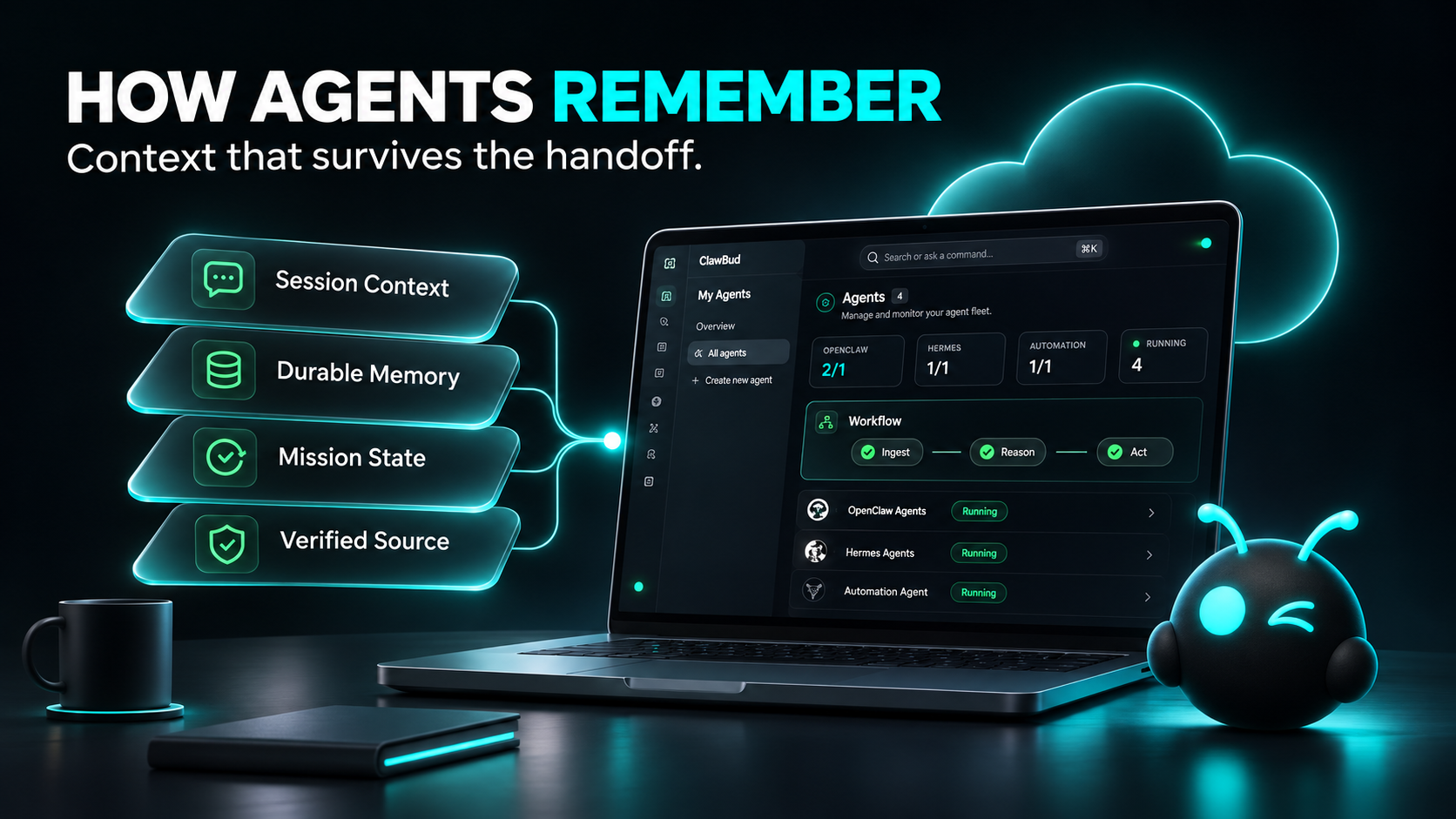
Keep the current conversation in session context, reusable decisions in a memory store, and task progress in an explicit workflow record. Read changing information from the application that owns it before an agent acts. A remembered ticket status can explain an earlier decision; it cannot establish whether that ticket is still open.
Reviewed November 10, 2026 by ClawBud, an AI Buddy company. This guide proposes a memory design and acceptance checks. The checks have not been performed, and no customer result or recall benchmark is reported.
The image is a conceptual illustration with a drawn interface. It is not a screenshot of ClawBud or evidence that the proposed memory checks were performed.
Give each kind of information a home
Start with the task. An agent preparing a support reply needs the current request, relevant prior decisions and the state of its own work. Saving every retrieved document into one growing conversation makes it harder to inspect which information controlled the reply.
| Place | What belongs there | What to check |
|---|---|---|
| Session context | The current conversation and recent tool results | What remains available after compaction or a new session |
| Searchable memory | A reusable preference, decision or procedure with its source | Who may retrieve it, how it is corrected and when it expires |
| Workflow record | Owner, current step, approval state, blockers and output links | Whether another worker can resume from the recorded state |
| Source application | Current ticket, CRM, order, calendar or document data | Its live value and the caller's permission for the intended operation |
A meeting preference may be worth remembering, while appointment availability still comes from the calendar. A previous contract summary can help locate a clause, while the signed document remains the source for its wording. Store a reference to the source when copying the whole record would add sensitive information without helping the task.
Save a record that someone can correct
For each durable memory, record the subject, statement, source link, owner and review date. Add an expiry or a condition for checking it again when appropriate. Identify summaries as summaries and retain the link to the material they summarize. An operator should be able to find the record and explain why it was retrieved.
Define the correction path before collecting a large history. When a preference changes, update or supersede the stored record and check the index used for retrieval. Decide what happens to the original transcript, exports, caches and backups. Deleting one memory entry does not establish that every copy of its source has been deleted.
Keep API credentials in the authorized secrets store. For customer details, limit collection and retrieval to the task and its permitted audience. A semantically similar record from another customer is still the wrong record. Privacy and retention requirements depend on the organization and use case; agree on those requirements before enabling collection.
Carry the work across sessions
At a handoff, save what was attempted, what completed and what remains uncertain. Include the output location and the next permitted action. If a write may have succeeded but its response was lost, record that uncertainty. The next worker should read the destination before deciding whether to retry. The workflow recovery guide covers that decision.
Keep session handling separate from the decision to save durable knowledge. OpenClaw's session documentation describes session state and compaction, while its memory documentation describes workspace memory and retrieval. Check the installed runtime and selected memory backend: current upstream documentation can describe options that are unavailable in an older deployment.
OpenAI's conversation-state guide documents both application-supplied history and API-managed conversation state. It also explains the finite context window. Anthropic's context-window documentation describes the material a model can reference for a response. These mechanisms can carry conversation history; the application still needs rules for business-record ownership, retrieval permissions and corrections.
Read live data before the consequential step
Consider a proposed exercise called memory-review-001, using an invented support ticket. The agent remembers that the ticket needed a follow-up. An operator then closes it in the source system. When the agent prepares its next action, it should retrieve the current ticket and reconsider the follow-up. No message should be sent merely because an older memory says one was needed.
Record the ticket reference, the remembered statement and the current source value separately. If they disagree, give the responsible person enough information to resolve the conflict. A fresh read can itself become stale before a later write, so verify the selected connector's update conditions before claiming that a workflow prevents concurrent changes. The CRM operating guide explains record matching, review and destination checks.
An approval should identify the recipient, content and operation it covers. Record the event with the workflow. Do not treat a past approval as blanket permission for a changed action. A memory search result is also information to assess, including when it contains instructions copied from an external document.
Check retrieval, correction and recovery
The following are proposed checks for an authorized test environment. Use invented records, specify the expected behavior first and leave the result blank until the check has actually run:
- Save a sourced preference, start another session and inspect which record the agent retrieves. Check that a different customer's task cannot retrieve it.
- Correct the preference. Check both the saved record and the retrieval result, including whether an old summary still controls the response.
- Remove the memory and inspect the intended deletion scope across search, transcripts, exports and caches. Record any retention exceptions.
- Close the invented ticket in the source system. Check that the proposed follow-up uses its current state and that no outward message was sent.
- Restore an authorized backup in a test environment. Compare the records, index, access settings, workflow state and source links against the expected recovery point.
For each check, save the observed result, evidence location and reviewer decision separately from the expectation. A successful retrieval on one attempt does not establish reliable recall across every task. Keep any unresolved correction or access failure visible before expanding the workflow.
What to confirm in ClawBud
ClawBud provides a managed account workspace for running agents and organizing their work. Standard OpenClaw agents can have separate identities, workspaces and sessions while sharing the account VM, gateway, tools and provider credentials. That arrangement does not by itself establish a customer or role boundary for shared memory. Additional managed isolation has restricted availability; consult the current Agent API reference for the supported scope.
Before choosing a deployment, confirm which memory backend is enabled, who can read its files, what the backup covers and how a correction reaches the retrieval index. If the organization needs the runtime in its own cloud account or a specific recovery policy, resolve those requirements with the provider. Self-management gives the operator responsibility for implementing and checking those parts. The managed versus self-hosted guide sets out the operational questions.
Keep the first workflow narrow enough for its owner to inspect a retrieved record, change it and verify the next result. Expand the saved context only when another source or record serves a defined task.